

Plastic/Resin
- Major types of marking/processing
- Mechanism of plastic color development
- Ratio of absorption into plastic
- ABS Plastic
- Epoxy Plastic
- 宠物塑料
本节介绍了塑料激光标记和处理的基础。学习怎样激光标记are used on plastic parts (such as ABS, epoxy and PET) and see some marking examples.
Major types of marking/processing
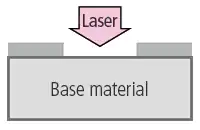
1: Paint peeling
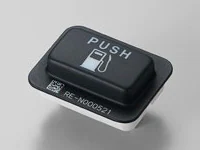
Peel the paint or printing on the target surface to bring out the contrast with the color of the base material.
(示例)汽车仪表板开关
Conventional methods (like printing and stamping) require full plate changeovers when a design change occurs. With a laser marker, you can adjust layouts by simply changing the program.
2:表面层剥离
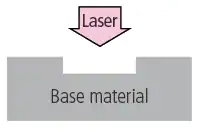
用激光卸下/雕刻表面层。
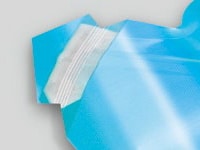
(Example) Half cut
A laser marker can be used to easily process a cutting section. Physical cutters are conventionally used in these scenarios, but they're difficult to adjust and time-consuming to change. Moreover, physical blades must be replaced often (incurring hard costs) and there's a risk that the blade will come loose and get left in the product.
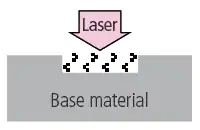
3:颜色开发
Irradiate a plastic target with a laser to develop a color in the target itself.
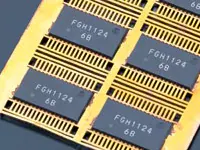
(示例)LSI上的广阔区域标记
By using laser radiation to develop a color instead of engraving the plastic, damage from marking the target is minimized.
4:焊接
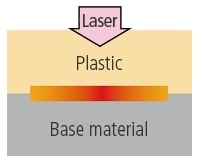
Use the heat of laser radiation to weld and join plastic parts.
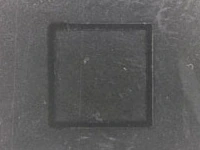
(Example) Welding of transparent plastic and colored plastic
Traditional welding can cause vibration which may affect the product or produce burrs. Since laser welding does not make contact with products, it won't damage them or produce burrs.

Mechanism of plastic color development
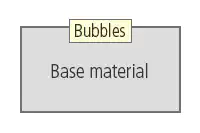
1: Foaming
当基本材料被激光照射时,由于辐射的热效应,在材料内部产生气泡。气体气泡包含在基本材料的表面层中,并产生白色的肿胀。当基本材料具有深色时,肿胀是高度可见的,通常比标记之前更轻。
- (示例)基本材料颜色:
-
- Black→
- 更改为Gray
- Red→
- 更改为Pink
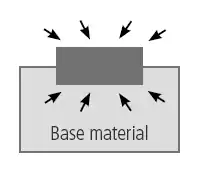
2:冷凝
When a base material absorbs the laser energy, the thermal effect increases the molecular density.
The molecules are condensed and the color becomes darker.
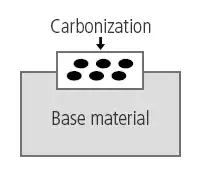
3: Carbonization
When an area is continuously irradiated by laser light, macromolecules of the element around the base material are carbonized and turn black.
4: Chemical change
The “pigment” elements in a base material typically contain metallic ions. Laser radiation changes the crystal structure of the ions and the hydration level in the crystal. Consequently, the composition of the element itself changes chemically, resulting in color development due to the increased intensity of the pigment.

Ratio of absorption into plastic
Ratio of absorption into materials depending on wavelengths
The graph below shows the absorption rates of various laser wavelengths on common resins The graph includes data on fundamental lasers (1064 nm), green lasers (532 nm) and UV lasers (355 nm). As a laser's wavelength becomes shorter, it's absorption rate on most plastic increases. Therefore, UV lasers are typically the best systems to choose for resin marking applications.

ABS Plastic
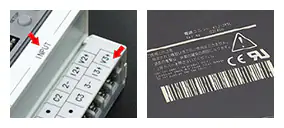
黑色的标记 /白色标记
激光照射根据目标塑料的颜色产生高度可见的黑色 /白色标记。结果,激光标记提供了无法删除的印刷表面。
Selection factors
Mark contrast and density are both important factors to consider when choosing a laser marker for plastics. Laser markers capable of producing a high peak power are optimal (such as a hybrid 1064 nm laser or UV 355nm laser). CO2也可以使用激光标记,但通常不会变色塑料表面。
Recommended model
3轴UV Laser Marker MD-U Series

Epoxy Plastic
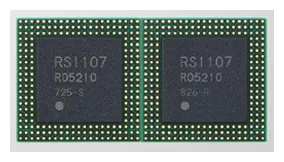
White Marking
Laser markers can easily create clear, white marks on epoxy plastics. They're great replacements for stamps, labels and printers. The highly-visible, print-like markings do not disappear like ink.
Selection factors
移动激光标记的焦点可以使高级打印具有良好的可见性,同时将标记深度保持在最低限度。
Recommended model
3轴混合激光标记MD-X Series

宠物塑料
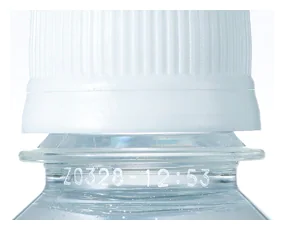
在透明/半透明的宠物塑料上可以使用白色角色标记。激光标记能够标记宠物瓶,薄膜和大多数产品之间,而不会留下销孔。
Selection factors
高功率激光束会过热目标并创建针孔。co2lasers with a short wavelength (9.3 μm) enable clear marking with minimal damage.
- Standard wavelength
-
Conventional method
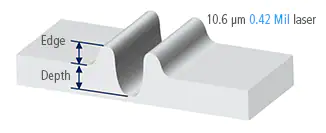
损害是过度和雕刻are deep and rough
- Short wavelength
-
ML-Z
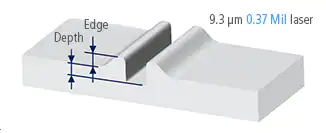
Damage is minimal and engravings are shallow and sharp
Recommended model
3轴Co2Laser Marker ML-Z Series


